Christy Mathewson

| Birthdate | 08/12/1880 |
| Death Date | 10/7/1925 |
| Debut Year | 1901 |
| Year of Induction | 1936 |
| Teams | Giants, Reds |
| Position | Pitcher |
Christy Mathewson is the only man in history to rank in the top 10 all-time list in wins & ERA. He was part of the 1936 original induction class.
Leave a commentIn the collection:

Christy Mathewson was elected to Cooperstown in the first Hall of Fame ballot
Christy Mathewson was elected to Cooperstown in the first Hall of Fame ballot
This book photo is signed by the Christian Gentleman, one of the first five inductees into the National Baseball Hall of Fame. With 373 wins and a microscopic lifetime earned run average of 2.13, Mathewson was elected in the very first Hall of Fame election of 1936. His autograph is much sought-after and especially difficult to locate as he died 1925.
Class president at Bucknell University, Mathewson was a rare educated man during baseball’s rowdy era. In college he was a fullback, punter and dropkicker who played his way onto Walter Camp’s 1900 All-America team.

Chief Meyers writes about Matty's 342th win that tied Tim Keefe for #4 on the all-time list
Chief Meyers writes about Matty's 342th win that tied Tim Keefe for #4 on the all-time list

On May 19, 1914 Christy Mathewson pitched his fourth complete game in 23 days to beat the Cincinnati Reds. The win was the 342nd of his career and elevated Matty to a tie for #4 on the All Time wins list with Tim Keefe. The only hurlers who had more victories were Cy Young (511), Pud Galvin (365), and Kid Nichols (362).
In the collection is this letter dated and signed that day by Matty’s primary catcher, Chief Meyers. An essential piece to John McGraw’s three consecutive National League championship teams, Meyers was one of the best-hitting catchers of the era. During those pennant-winning seasons of 1911-1913, Meyers led the Giants in average each year while hitting .334 with a .407 on-base percentage.
Here Chief endorses a catchers mitt made by Goldsmith’s Sons sporting goods.
The Native American from the Cahuilla culture writes, “In the game today, with the Cincinnati club with Mathewson pitching, I used the Model C.M. Catcher’s Mitt, made for me by your firm yesterday.
“In my many years of experience, I have never had a Catchers Mitt that I could use without extensive breaking in.
“The perfect balance, deep pocket, and excellent leather make it The Finest Mitt I have ever caught with.”
Meyers has boldly signed the bottom of the letter, “Chief John T. Meyers”.

Judge Landis praises Christy Mathewson, Mordecai Brown, and Walter Johnson
Judge Landis praises Christy Mathewson, Mordecai Brown, and Walter Johnson

Christy Mathewson retired in 1916 with 373 wins and remained on the minds of baseball fans and the American public alike. The legendary hurler was among the inaugural Hall of Fame class in 1936.
Five years after Matty’s retirement Baseball Commissioner Judge Kenesaw Mountain Landis wrote this letter praising the New York Giants great along with fellow Cooperstown classmate of ’36 Walter Johnson and two-time Cubs world champion Mordecai “Three Finger” Brown.
“Walter Johnson is one of the outstanding characters of the game. You can’t think of it without thinking of him,” Landis writes in the second paragraph. Appointed as a federal district court judge by President Teddy Roosevelt, Landis continues, “Men like he (Johnson), Mathison (sic), and Old Mordecai Brown, and a host of others, made a real contribution to our society.”
Landis was just three months into his 23-year reign as the baseball chief when he wrote the letter. Despite this, it’s difficult to read the misspelling of Matty’s last name by a man who should know better.
Though Landis letters are plentiful due to his position as commissioner, early letters with such outstanding baseball content are quite difficult to come by.
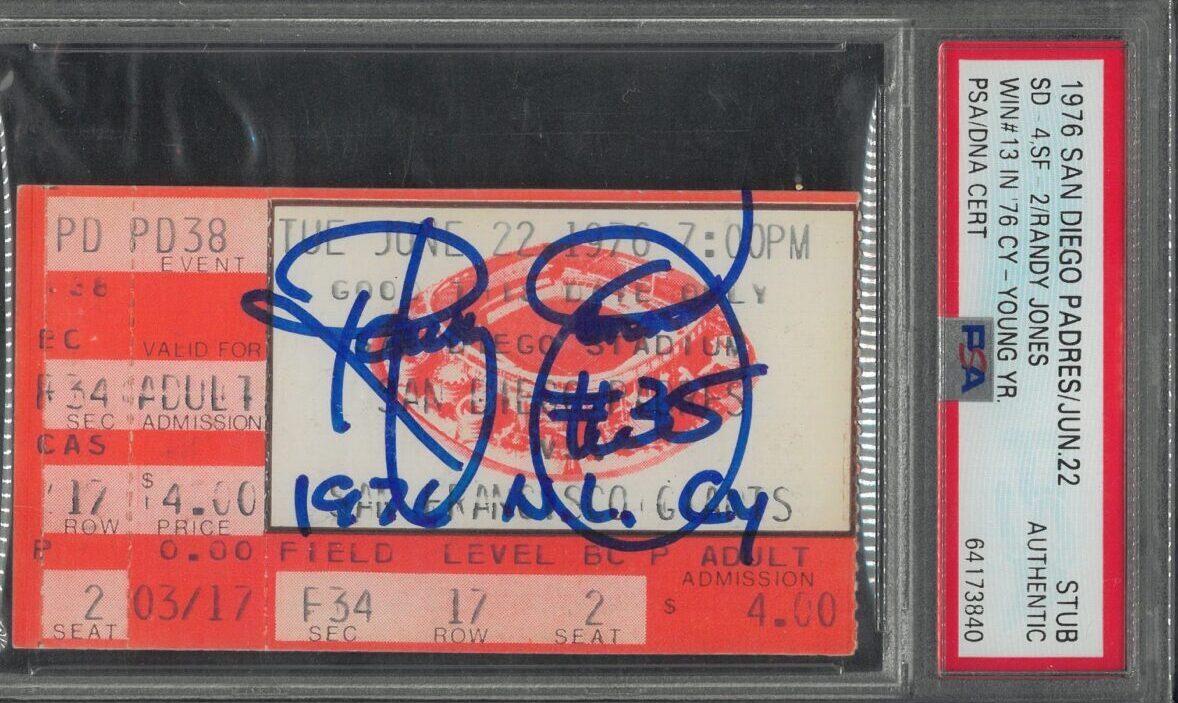
In 1976 Randy Jones tied Matty's NL record for consecutive innings without issuing a walk
In 1976 Randy Jones tied Matty's NL record for consecutive innings without issuing a walk
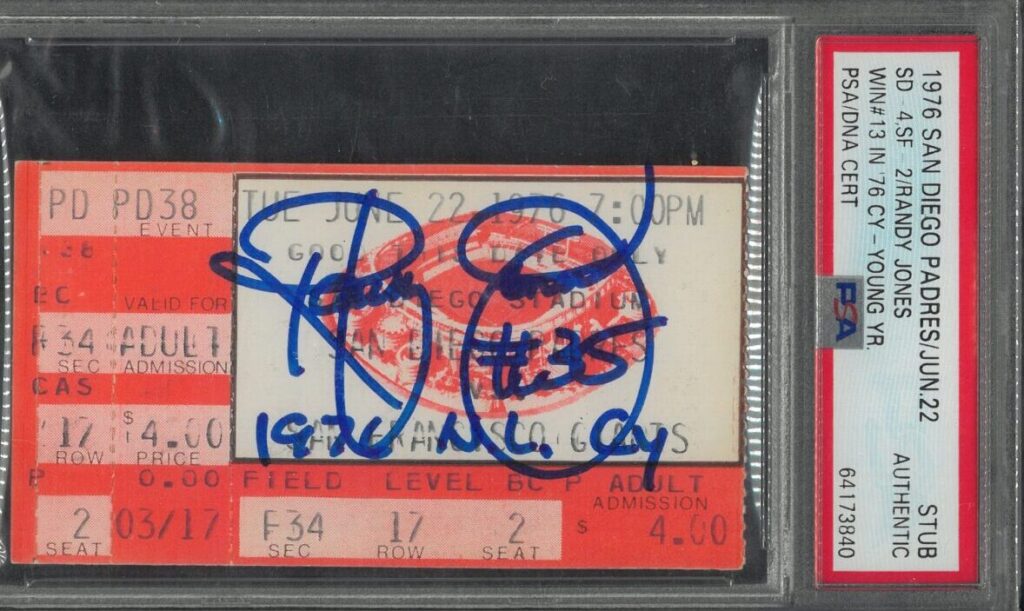
For a 37-day period in 1976, Randy Jones put together a remarkable string of command and control. After walking Steve Ontiveros in the 8th inning on May 17, Jones reeled off 68 consecutive frames without walking a single batter.
When he struck out Darrell Evans in the 7th inning of a tie game on June 22nd, Jones tied Christy Mathewson’s 1913 NL mark of pinpoint control. In the bottom half of the inning, Jones singled and came around to score the winning run.
The next inning Jones’ 3-2 sinker to Giants catcher Marc Hill fell out of the strike zone and the streak ended. Matty and Jones now shared the record.
Shown here is a PSA slabbed ticket for the night Randy tied the great Christy Mathewson. Jones signed the ticket, adding his “#35 1976 NL Cy”.

Christy Mathewson's 88-year old record was surpassed by Greg Maddux; here's the lineup card from the dugout
Christy Mathewson's 88-year old record was surpassed by Greg Maddux; here's the lineup card from the dugout

Christy Mathewson’s plaque in Cooperstown calls him, “Greatest of all the great pitchers in the 20th century’s first quarter…” and ends with, “Matty was the greatest of them all.”
Many of his records have stood the test of time. One such record is Matty’s 1913 National League mark of 68 consecutive innings without allowing a base on balls. The Christian Gentleman stood alone with 63 years until San Diego’s Randy Jones tied him in 1976.
The duo held the mark together for the next quarter century when Braves great Greg Maddux passed them both.
In the collection is this lineup card from the Braves dugout from August 7, 2001. That’s the might Maddux broke Mathewson’s 88-year old National League record.
The Atlanta hurler came into the contest just 3 2/3 inning short of the mark. When Maddux retired Houston’s Jeff Bagwell to end the fourth inning, the record was his. Maddux extended the record to 72 1/3 innings before issuing an intentional pass to Arizona’s Steve Finley.
Notice Maddux’s autograph and inscription at the bottom, “Broke Mathewson’s NL walkless inn record”. Braves skipper Bobby Cox also penned his signature in the middle near the bottom of the card.

Collectors seeking Matty's autograph got creative in their quest
Collectors seeking Matty's autograph got creative in their quest
Collectors of Hall of Fame autographs got started early. In this letter National League President Ford Frick responds to a fan’s request about obtaining a Christy Mathewson signature. The letter is dated August 2, 1939, less than two months after the Hall’s first induction ceremony on June 12, 1939.
Frick eventually gained induction in his own right in 1970.
The recipient of this letter is collector Myron Green who would continue his search for Matty’s autograph. The next image shows a letter to Green from Giants owner Horace Stoneham. Dated 23 after Green’s request to Frick, the letter got Green no closer to finding Mathewson’s signature.

Giants owner Horace Stoneham responded to requests for Matty's signature
Giants owner Horace Stoneham responded to requests for Matty's signature

The same autograph hound who received the letter shown in the preceding image continued his search for a Christy Mathewson autograph.
Dated april 27, 1962, the letter comes 23 years after the previous attempt. This time autograph collector Myron Green turns to Giants owner Horace Stoneham in hopes of getting Matty’s signature.
Stoneham writes, “I regret we haven’t anything here with Christy Mathewson’s signature. As a suggestion, your friend might write to Mrs. Mathewson in Lewisburg, Pa. I understand in the past she has been able to answer similar requests by tearing his signature from old canceled checks which she had saved, and it is possible she may still have some on hand.”
Imagine the ingenuity and commitment this collector had to contact both the NL president in 1939 and the Giants owner in 1962.

Christy Mathewson came to the Giants in a trade for HoFer Amos Rusie on 12/15/1900
Christy Mathewson came to the Giants in a trade for HoFer Amos Rusie on 12/15/1900
John T. Brush owned the Reds while eyeing the Giants. After the 1900 season, Brush as Reds owner “traded” Christy Mathewson straight up for the sore-armed Amos Rusie who hadn’t pitched since 1898.
Bush sold his share in the Cincinnati club and bought the Giants for whom Matty was pitching. Rusie, the “Hoosier Thunderbolt” was one of the most feared pitchers of his day. The first half of his career pitchers stood just 50 feet away from the batter.
Armed with a 90+ fastball, Rusie was not known for his control. He once hit future HoFer Hugh Jennings in the head, putting Jennings into a four-day coma. Rusie won 20 or more games in eight straight seasons.
Inducted into the Hall of Fame in 1977, Rusie died in 1942 and remains a difficult autograph to obtain. This image shows a closeup of his signature on a government postcard complete with a postmark from Seattle, Washington where Rusie resided in his final years. The man once traded for Christy Mathewson won 246 games in his ten-year career.
The postcard with Rusie’s autograph is postmarked June 1, 1940, a mere 18 months before his death there.

Reverse of Amos Rusie signed GPC with 6/1/1940 postmark from Seattle, Washington
Reverse of Amos Rusie signed GPC with 6/1/1940 postmark from Seattle, Washington

Government postcards provide aid to authenticating autographs. Collectors would send a postcard to the desired target. When the autograph returned in the mail it would contain a postmark verifying the exact date and place from where it was mailed.
This postmarked reveals a June 1st, 1940 mailing from Seattle, Washington where Amos Rusie would die 18 months after he signed this.

Mathewson calls Tuxedo, "good, honest, companionable tobacco" in this original ad from 1916
Mathewson calls Tuxedo, "good, honest, companionable tobacco" in this original ad from 1916

Tuxedo Tobacco pulled together the greatest baseball players of the day for this advertisement. Hailing itself as, “The Perfect Pipe Tobacco”, Tuxedo secured the services of Christy Mathewson, manager of the Cincinnati Reds.
According to the advertisement, Mathewson says, “Tuxedo gets to me in a natural, pleasant way. It’s what I call good, honest, companionable tobacco – the kind to stick to”.
Also featured in the ad are Hughie Jennings, Joe Tinker, Wilbert Robinson, Tyrus R. Cobb, and G.C. Alexander.


