Kirby Puckett
| Birthdate | 3/14/1960 |
| Death Date | 3/6/2006 |
| Debut Year | 1984 |
| Year of Induction | 2001 |
| Teams | Twins |
| Positions | Center Field, Designated Hitter, Right Field |
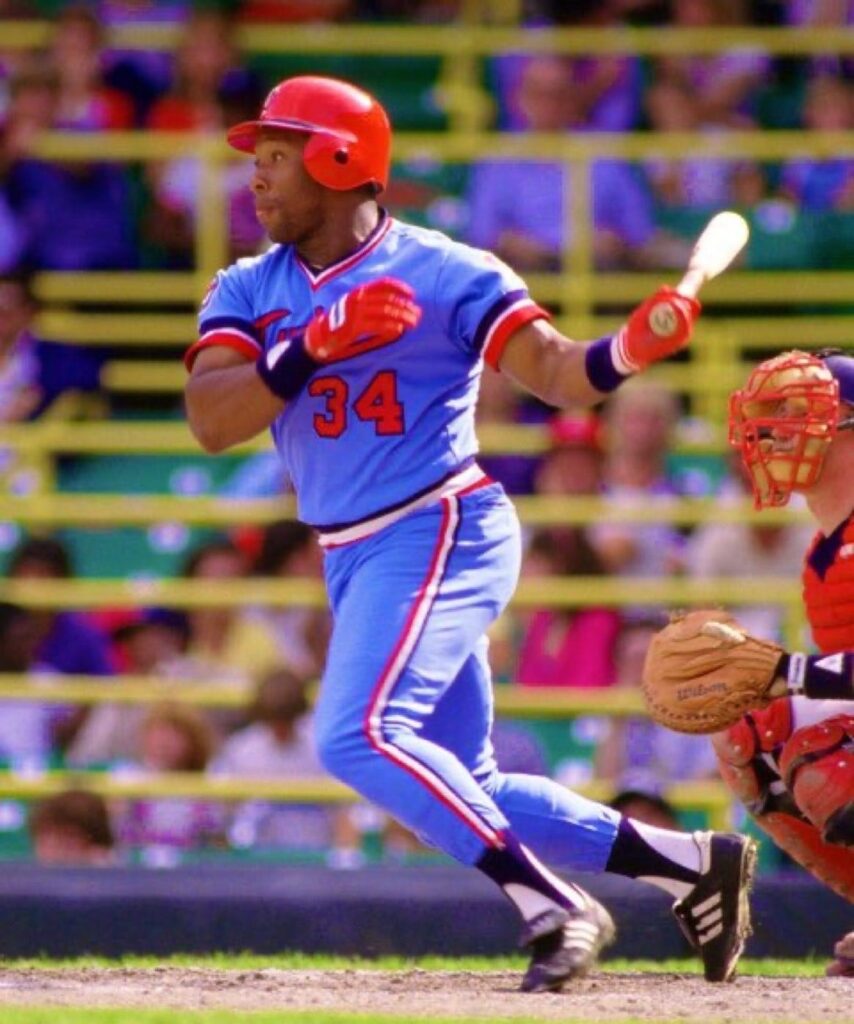
Kirby Puckett played all twelve of his big league seasons in Minnesota and retired as the Twins’ All Time leader in hits, runs, doubles, and total bases.
Leave a commentIn the collection:

Kirby Puckett burst onto the scene in 1983 with a third-place finish in Rookie of the Year balloting
Kirby Puckett burst onto the scene in 1983 with a third-place finish in Rookie of the Year balloting

Drafted by the Twins with the 3rd overall pick in 1983, Kirby Puckett was in the big leagues to stay the following season. The 24-year old centerfielder was spectacular with his glove in ’84. At 5’8″, 185-pounds, he posted a 3.3 dWAR, second in the majors behind only Baltimore shortstop Cal Ripken Jr.
Offensively, Puckett was solid. He finished third on his club in runs, fourth in hits, and third in batting average. The performance earned Kirby a third-place in Rookie of the Year balloting.
The following season Puckett tallied 199 hits and received support in MVP voting. In ’86 Kirby established himself as one of the game’s best with the first of four straight Silver Slugger and Gold Glove seasons. He also began a run of 10-straight All Star appearances.
In the collection is this team sheet signed by 27 members of the 1984 Twins including rookie Kirby Puckett.
In 1987 Kirby Puckett helped the Minnesota Twins win their World Series title
In 1987 Kirby Puckett helped the Minnesota Twins win their World Series title
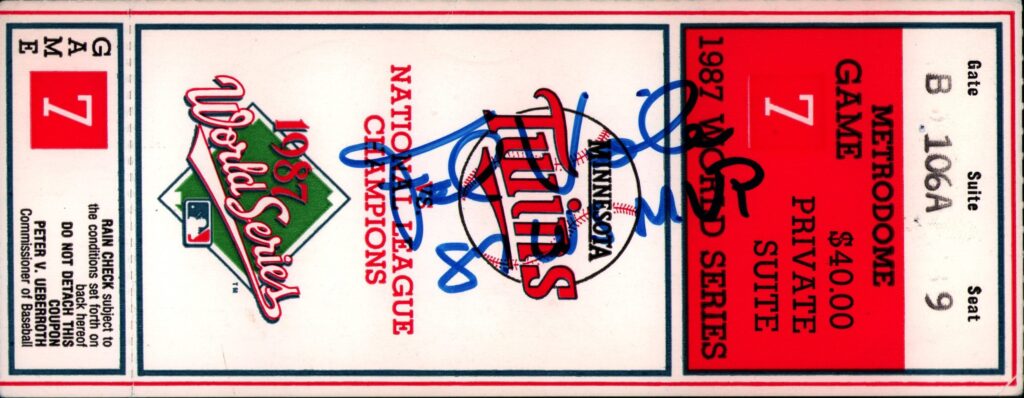
After losing 91 games in 1986, the Twins caught fire in ’87. A .500 mark found them in second place on May 26th after 44 games. By June 9th they caught Kansas City and never relinquished first place.
Thirty-homer men Kent Hrbek, Tom Brunansky, and Gary Gaetti were complimented by position-player WAR leader Kirby Puckett. On the mound aces Frank Viola and Bert Blyleven gave the Twins a chance in any Series.
Together they dispatched the Tigers in five games in the ALCS. In the Fall Classic the 95-win NL champion Cardinals proved formidable. After Viola and Blyleven dealt the Twins to a 2-0 Series lead, St. Louis battled back and won three straight.
When the Series returned to Minnesota so did the Twins dominance. An offensive barrage in Game 6 resulted in an 11-5 home-team victory. With everything on the line they turned again to Viola.
He responded by scattering six hits through eight-innings, leaving the game with his Twins leading 3-2. Minnesota pushed across an insurance run in the bottom of the 8th before closer Jeff Reardon slammed the door.
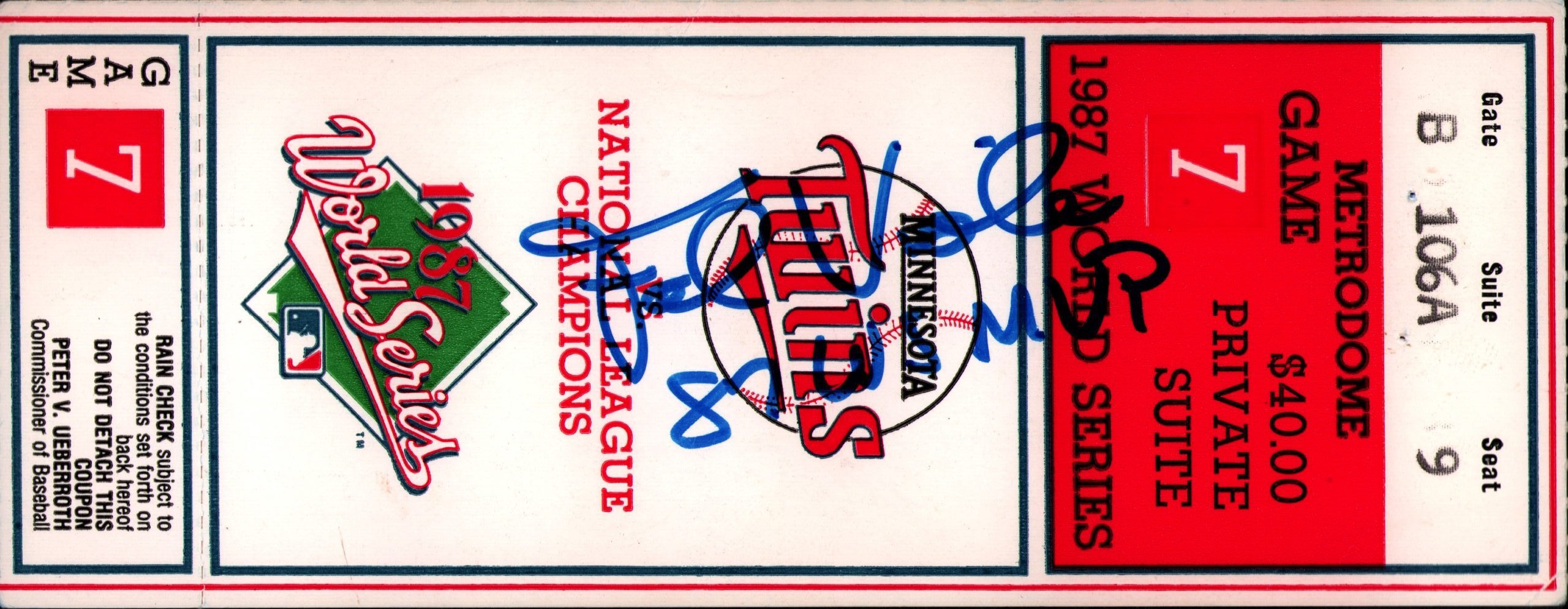
Shown here is a ticket to the deciding Game 7 singed by World Series MVP Frank Viola who added the inscription, “87 WS MVP”.

Puckett's Game 6 walk-off homer helped the Twins to their second World Series title in five seasons
Puckett's Game 6 walk-off homer helped the Twins to their second World Series title in five seasons

Kirby Puckett closed the 80s with four-straight All Star selections to go along with four Gold Gloves and four Silver Sluggers. For good measure he won the batting championship in the final year of the decade.
Though the Twins finished last in 1990, Puckett made the fifth of his ten-straight All Star appearances. The following year Minnesota turned it around with a 95-win campaign.
Puckett made the most in his postseason return in the 1986 ALCS. His two homers and six RBI led both teams and helped the Twins made quick work of the Eastern Division Toronto Blue Jays. As ALCS MVP, Puckett hit .429 with a .762 slugging percentage.
The 1991 Fall Classic featured baseball’s first pair of worst-to-first clubs. Only the pitching-rich Braves behind Tom Glavine, John Smoltz, and Steve Avery stood between the Twins and their second title in five years.
After the home team won each of the first four games the Series, the Braves continued the trend with a 15-4 drubbing of the Twins in Game 5 at Fulton County Stadium. One win away from their first title since 1957, the Braves flew to Minnesota.
Game 6 provided Puckett’s signature moment. With the game tied at 2-apiece, Puckett led off the bottom of the 11th. On a 2-1 pitch, Puckett slammed Charlie Leibrant’s fastball toward the wall in left-center. As the ball cleared the fence to force a Game 7, announcer Jack Buck made his famous walk-off call, “And we’ll see you tomorrow night!”
Game 7 provided a Hall of Fame matchup between Smoltz and Jack Morris. The Braves right-hander pitched valiantly, scattering six hits in 7 1/3 scoreless innings. Twins starter Jack Morris was even better, holding Atlanta scoreless though through ten innings. In the Minnesota half of the 10th Columbia University alum Gene Larkin walked off the Braves with a bases-loaded single. Puckett and the Twins were champions of baseball.
Shown here is a ticket signed by the man who went up against Morris that night, Braves John Smoltz. The ticket is to the April 27, 2008 contest when Smoltz recorded his 3,000th strikeout.
From 1986-1992 Puckett hit .329 and averaged 207 hits, 20 homers, 97 RBI per season
From 1986-1992 Puckett hit .329 and averaged 207 hits, 20 homers, 97 RBI per season

Kirby Puckett was among the game’s best hitters from 1986-1992. An all star all seven of those years, he earned five Silver Sluggers. For good measure, the center fielder also earned six Gold Gloves.
The run saw Puckett lead the league in hits four times, total bases twice, and batting average and WAR once each. He averaged 206.9 hits, 37.6 doubles per season while hitting .329 with a 134 OPS+.
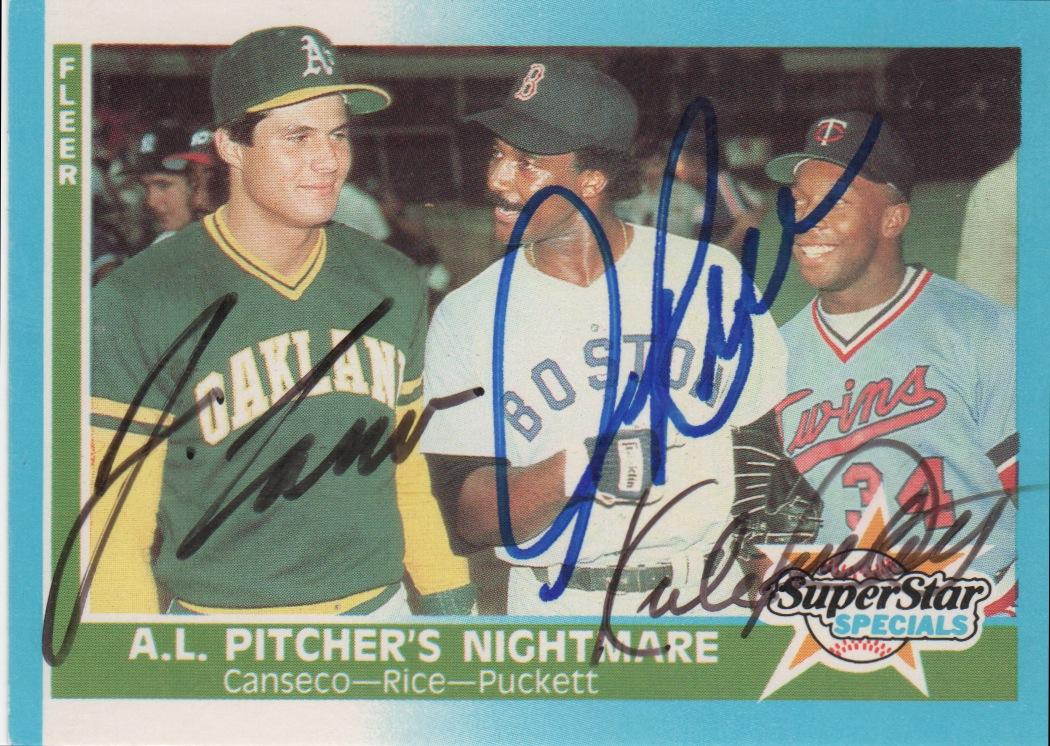
Shown here is the 1987 Fleer baseball card titled, “A.L. Pitcher’s Nightmare”. When this picture was taken at the 1986 All Star game, Puckett, Jose Canseco and Jim Rice were three of the most feared sluggers in the American League.
It was a season of firsts for Puckett who had never before played in an the All Star game, won a Silver Slugger or Gold Glove Award but accomplished all three in ’86.
All three outfielders penned their signatures on this card.

Kirby Puckett was one of six in the inaugural Twins Hall of Fame class in 2000
Kirby Puckett was one of six in the inaugural Twins Hall of Fame class in 2000

The Minnesota Twins created their team Hall of Fame in 2000. Their first induction class included All Star Kent Hrbek, owner Calvin Griffith, and Cooperstown men, Harmon Killebrew, Rod Carew, Tony Oliva, and Kirby Puckett.
The 5’8″ Puckett electrified Twins fans from 1984 through 1995. An All Star for Minnesota in each of his final 10 seasons, Pucket earned six Gold Gloves and Six Silver Sluggers. He was a key player in both the 1987 and 1991 championship seasons.
The Twins retired his #34 in 1997. Three years later his induction in the inaugural class of the team’s Hall of Fame capped it all off.
Shown here is a letter from another Twins Hall of Famer who had his number retired. Fellow 2000 inductee Killebrew writes to Jack Lang, the secretary-treasurer of the Baseball Writers Association of America (BBWAA) from 1966-1988. The role entrusted Lang with counting Hall of Fame votes and notifying those who made it.
The correspondence is dated January 16, 1984, just one week after Killebrew received the good news.
He writes in part, “What a thrill to hear these words from you last week…It is the greatest thrill of my life and we look forward to being with you and the rest of my friends along with Don Drysdale and Luis Aparicio on August 12.”
The slugger signs his name at the bottom of the letter.
In 2001 Puckett and three others received their plaques in Cooperstown
In 2001 Puckett and three others received their plaques in Cooperstown
The charismatic 5’8″ centerfielder, Kirby Puckett captivated Minnesota fans for a dozen years. The 1989 batting champ sparkled, averaging more than 200 hits in the nine-year period from 1985-1993.
Puckett’s most memorable moment came in Game 6 of the 1991 World Series. With his team down 3-game-to-2, Puckett’s walk-off home run prompted Jack Buck to exclaim, “And we’ll see you tomorrow night!”
Puckett’s fine career culminated on August 5, 2001 when he took the microphone at the Hall of Fame on his induction day. Minnesota fans flocked to Cooperstown and listened intently.
One of the other inductees that day shared Puckett’s World Series home run dramatics. Bill Mazeroski hit his in 1960, baseball’s only Game 7 World Series walk-off. Shown here is a 1961 Topps baseball card signed by Maz commemorating the event.
Mazeroski signed the card, adding the inscription, “HOF ’01 We Win!”
In addition to Puckett and May, Dave Winfield, Hilton Smith also received their plaques.