Baby Doll Jacobson

| Birthdate | 8/16/1890 |
| Death Date | 1/16/1977 |
| Debut Year | 1915 |
| Year of Induction | |
| Teams | Athletics, Browns, Indians, Red Sox, Tigers |
| Position | Center Field |
From 1919-1926, only Hall of Famers Sam Rice, Rogers Hornsby, Harry Heilmann, George Sisler, & Ty Cobb had more hits than Baby Doll Jacobson.
Leave a comment
In the collection:
Bill Jacobson got his nickname at age 21 while playing for Class-A Mobile 1912
Bill Jacobson got his nickname at age 21 while playing for Class-A Mobile 1912
Born in 1890, Bill Jacobson was a hulking man for his day. Standing at 6’3″ and weighing in at 215 pounds during his playing career, he also had one of baseball’s unlikeliest nicknames – “Baby Doll”.
Jacobson got tagged with the moniker in 1912. The 21-year old Jacobson was entering his third year of professional baseball, playing for the Class-A Mobile Sea Gulls. According to his SABR bio, Jacobson received the nickname in the home opener.
“Everybody called me Bill until that day in Mobile. It was opening day and a band was playing. Just before the first pitch, they struck up ‘Oh, You Beautiful Doll,’ a popular song at the time. Well, I led off with a homer on the first pitch and a lady sitting behind the plate jumped up and shouted: ‘You must be that beautiful doll they were talking about.’ The name stuck with me and that was it.”
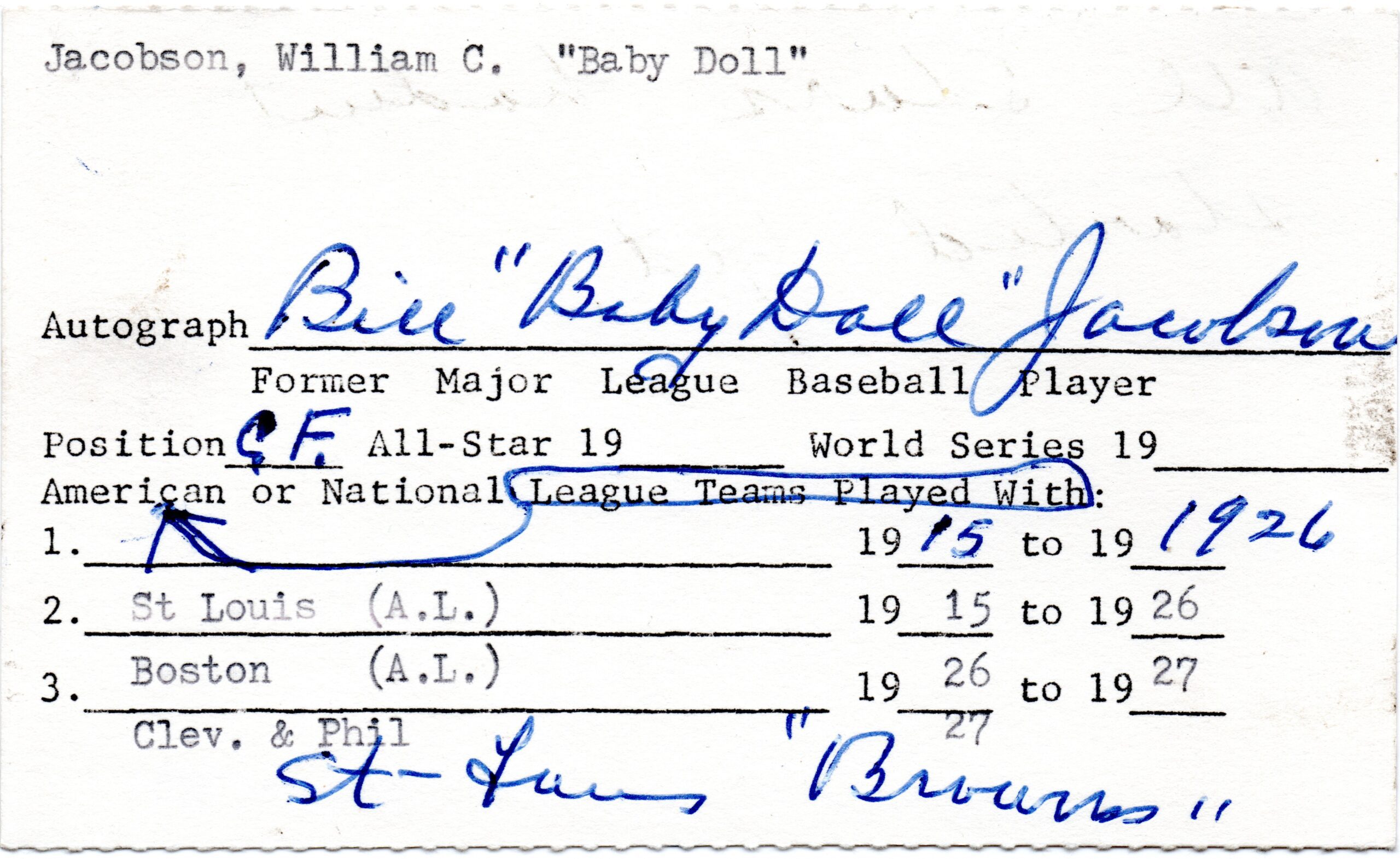
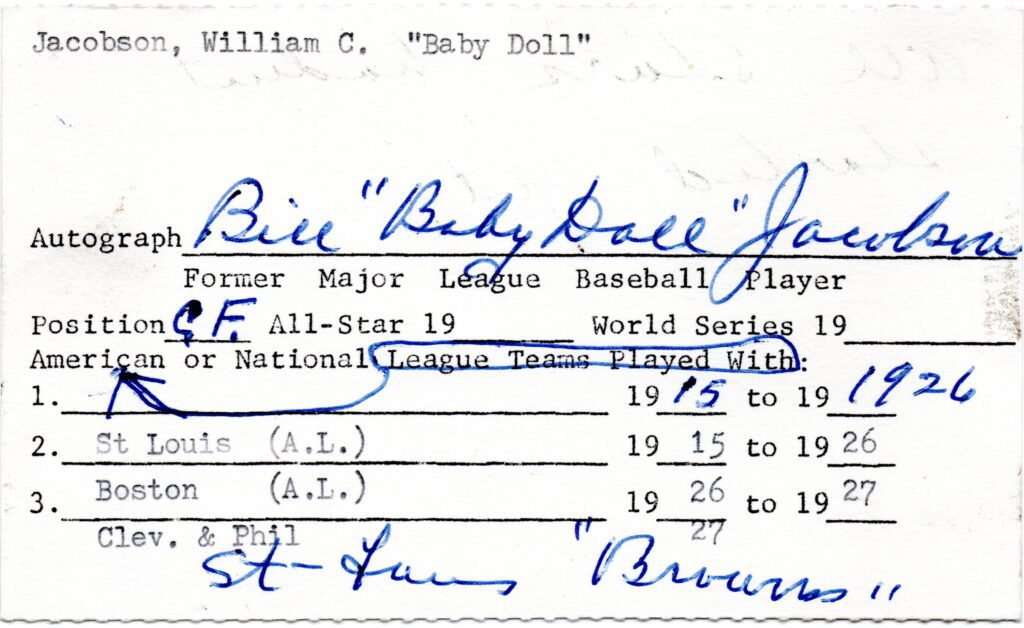
Shown here is Bill “Baby Doll” Jacobson’s autograph. Some of the detail about his playing career is in Jacobson’s hand.
William "Baby Doll" Jacobson hit over .300 in seven consecutive seasons and over .350 twice
William "Baby Doll" Jacobson hit over .300 in seven consecutive seasons and over .350 twice
William “Baby Doll” Jacobson reached the big leagues with the Tigers in 1915. A centerfielder by trade, Jacobson’s playing time in Detroit was limited with Ty Cobb in front of him. In August the Tigers traded him to the St. Louis Browns.
A slow start and his service in World War I kept Jacobson from hitting his stride until 1919. That season he was flanked in the St. Louis outfield by Ken Williams in left and Jack Tobin in right. The trio went on to start 556 contests together, the most by any outfield in baseball history.
Jacobson hit .323 in 1919 to start a run of 7 consecutive seasons of .300 or better. In ’20 Baby Doll had his finest season, hitting .355 with a .402 on-base percentage and a .501 slugging mark. His 122 runs batted in was topped only by Babe Ruth.
During the height of his career, Jacobson was one of the game’s most productive players. From 1919-1926, only Hall of Famers Sam Rice (1,639), Rogers Hornsby (1,626), Harry Heilmann (1,556), George Sisler (1,495), and Cobb (1,478), had more hits than Baby Doll (1,473).
Exceptionally agile for his size, he was considered one of the game’s finest defensive centerfielders. Each season from 1919-1925 he placed in the top 5 among AL flycatchers in putouts, leading the league three times.
Jacobson set or tied more than a dozen defensive records. His 488 putouts in 1924 stood as the American League mark until after the second World War.
In 1926 the Browns traded him to the Red Sox in a four-player deal. The following season he split time in Boston, Cleveland, and Philadelphia before ending his big league career. Jacobson’s lifetime average stands at .311. As of 2022 only 100 men in the history of the game have a higher tally.
Baby Doll continued playing in the minors and in a semipro league past his 40th birthday. After leaving the game for good, he became purchased a farm in Illinois not far from where he was born.
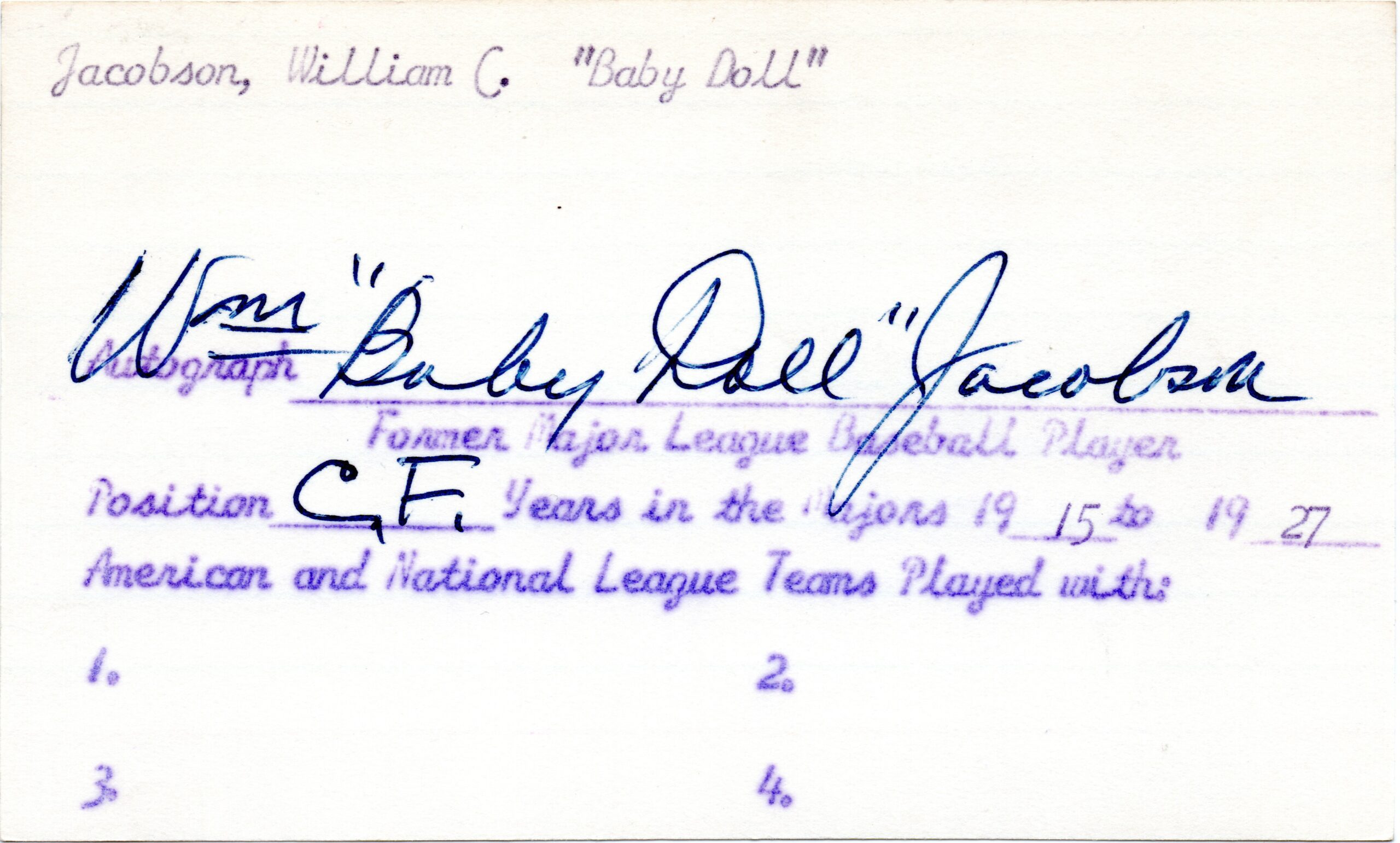
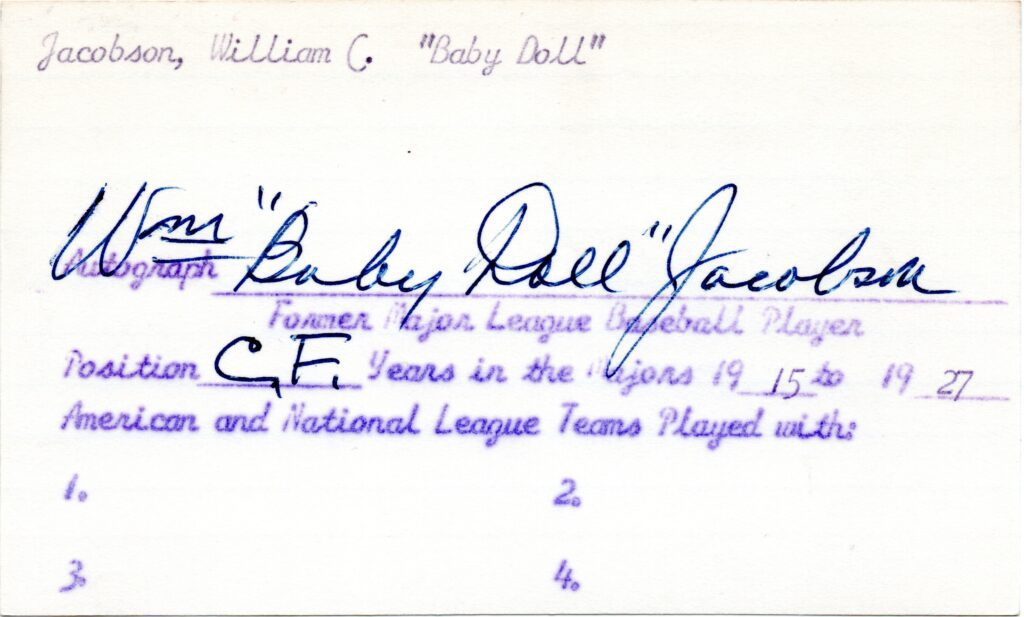
In the collection is this autograph of Wm. “Baby Doll” Jacobson. The centerfielder has written his position on the card which states that he was in the majors from 1915-1927.

Ken Williams Jacobson, and Jack Tobin of the Browns form MLB's longest-running outfield
Ken Williams Jacobson, and Jack Tobin of the Browns form MLB's longest-running outfield

Centerfielder Bill “Baby Doll” Jacobson teamed left fielder Ken Williams, and right fielder Jack Tobin to form the longest-running outfield in the history of the game. The trio started 556 games together for the St. Louis Browns from 1919-1925.
Only two other other trios made as many as 500 starts as a crew. The 1980s Toronto trifecta of Lloyd Moseby, George Bell, and Jessie Barfield fell just four games short of Jacobson and his mates. The other 500-game fly-catching trio was Bill Virdon, Bob Skinner, and Roberto Clemente who started 542 games together for Pittsburgh from 1956-1963.
During their 7 seasons together, the Jacobson, Williams, Tobin triumvirate combined for a .330 batting average. From 1919-1925 the three men totaled 1,670 runs batted in, 944 walks and just 556 strikeouts for the Browns.
Jacobson hit over .300 in each of his 7 seasons with his outfield mates. He topped the .340 mark three times, and the .350 mark twice. The centerfielder had his finest season in 1920 with 216 hits, 34 doubles, 14 triples, 305 total bases, a .355 average, .402 on-base percentage, and .501 slugging mark. His 122 RBI that year were bested only by Babe Ruth.
While sharing the outfield grass with Tobin and Jacobson, Williams led the league in homers once, finished second twice, and fourth another season. In 1922 he made baseball history by becoming the first man in MLB history to slug 30 homers and steal 30 bases in the same season. His 39 long balls led the AL. Williams and Bob Meusel are the only two men not named Ruth to lead the Junior Circuit in homers from 1918-1931. Click here for more on Williams.
The image above shows the signature of Ken Williams on an Heilbroner Baseball Bureau Service information card. The leftfielder writes that his age is 22, dating this to Williams’ first pro season with the Regina Red Sox of the Western Canada League. Examples of Williams signature that predate his big league debut are rarely seen.

5'8", 124-pound Jack Tobin tallied 1,906 career hits - the most among the outfield trio
5'8", 124-pound Jack Tobin tallied 1,906 career hits - the most among the outfield trio

Rounding out the Browns trio was Jack Tobin. Just 5’8 and 142 pounds, he packed quite a punch. He finished in his league’s top-ten in home runs in 1914, 1915, 1922, and 1923, and in total bases in 1915 and each of the four seasons from 1920-1923.
The right fielder’s finest campaign came in 1921. He tallied an astonishing 236 hits, a figure surpassed only 24 times in big league history. Tobin established a career-best in triples (18) and each of the slash line categories. Like Baby Doll Jacobson, Tobin hit .325. His on-base and slugging percentages were a robust .395 and .487, respectively.
The Browns outfield 7-year run together came to an end when the Browns sent Tobin to the Senators in February, 1926. Washington released Tobin on June 29th that same year. Two days later the Red Sox came calling. Tobin stayed in Boston until hitting .310 in his final big league campaign of 1937. His 1,906 career hits are the most of his outfield mates.
Shown here is a government postcard signed by Tobin. Notice the postmark from St. Louis dated September 7, 1951. Then 60 years old, Tobin was born, raised, and buried in St. Louis where he spent 11 of his 13 big league seasons.


